Showing posts with label F. Assignment 5: Animation. Show all posts
Showing posts with label F. Assignment 5: Animation. Show all posts
Friday, 15 June 2018

Wednesday, 13 June 2018
Research and Planning: Responding to the Brief
Research & Planning: Responding to the Brief
Learning to follow a brief in this task was a challenge and it was tempting to deviate at certain points however I did manage to follow the majority of the requirements in the brief. I managed to make the animation ten seconds long after adding some more onto the end. This was a struggle because it was hard to estimate how much footage you would end up with during the story-boarding stage. Another way is I used one of the required tunes given to us by E4. I really didn't like this requirement because I felt like it restricted creativity however I understand why this requirement was necessary due to copyright issues. Lastly I didn't include any offensive themes, I kept it family friendly and targeted it towards a younger audience.
The only significant change I needed to make to the end production due to brief requirements is extending the scene. At the end of filming I only found myself with 7 seconds of footage so I went back and filmed an extra scene bringing to the full 10 seconds with the logo included. The production was small scale so no health or injury risk measures we're taken.
I'm the only person involved in the production so I will be constructing models, taking the images and editing the footage. The production deadline is 15/06/2018.
Monday, 29 January 2018
Animation Evalutation

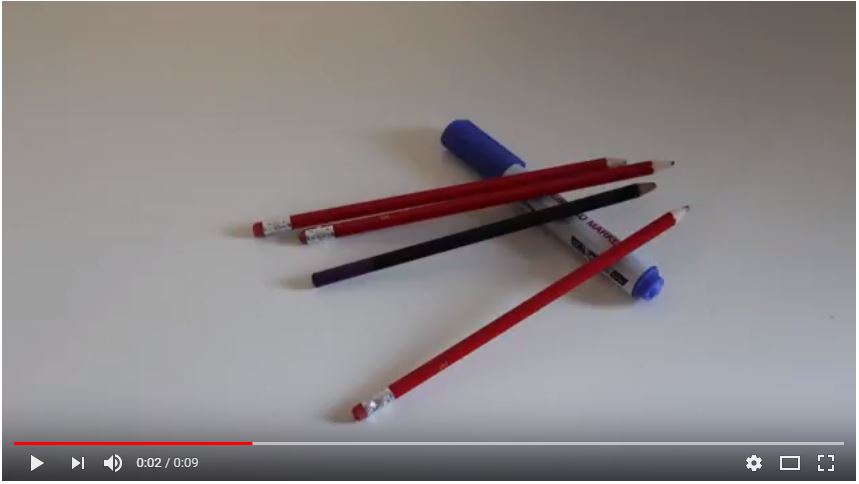
In my proposed ESting I wanted to create a whole battle scene rather than just focus on one individual character/object. My original idea was to have clay figures attacking a Lego castle and to have little Lego characters defending it. However when I began creating the set, i.e the castle and all the individual clay characters, I began to quickly realize I had bitten off a lot more than I could chew so to speak. In other words with the time pressures the scale of battle I wanted to create just wasn't possible. So half way into production I suddenly drastically switched ideas, opting to use inanimate objects of different colors/shapes, as warring factions instead. I ended up using pens vs pencils which worked well.
To exhibit my work and collect responses I first distributed my ESting video on social media services like YouTube, Facebook and Twitter. From this I was then able to ask family and peers to take a survey I created on survey monkey. From these responses I was able to draw a wide range of conclusions and make a good evaluation on what I could of done differently. Here are the questions I asked and the responses I got.
To review my animation project and responses I decided to write a written report. First few questions I asked were to profile the people answering and find out what demographic groups I'm getting responses from. In total twelve people answered my survey. Out of the twelve who answered, all were students aged between 16-20, a third of which were female and the other two thirds male.
I then began to ask what they thought about the animation. My first question in this was to ask what genre they would class it as. Two thirds of the responses (8/12) classed it as comedy, a quarter of responses classed it as drama (3/12) and one person answered Sci-Fi. I was attempting more of a drama genre with the animation trying to make a tense battle scene, however being animation I can see why more people may class it as comedy. I think its very hard to create a ten second short animation and be able to define it as a specific genre with the content in that time. Comedy was the expected response.

 My next question was a text box response I asked 'whats the biggest problem/error you can see?'. There were a range of answers, a couple including it being to short and having an unclear narrative, however having four people point out to me large frame drops in the middle five seconds in, and three people pointing out the sudden lighting change I can conclude these were definitely the two biggest errors in my animation.
Frame drops were due to me moving the objects quickly and not getting enough pictures in production which there's not too much you can do after, however the lighting could of definitely been changed through color correction in post production editing.
For my next question I asked them what might be their favorite aspect/element of the animation. I got a very wide range of answers here out of the twelve responses having offered a text box as response, however one that appeared three times was the fact it was clear to see what was happening and that I used larger pens for more 'important' characters giving them a sense of individuality.

 My penultimate question was asking if they found the narrative of the animation clear. I offered three answers, yes, no and partially. 83% of respondents (10/12) answered yes and the other 16% (2/12) answered partially. I feel like I completed my objective of having clear differing factions looking at these responses, however I am concerned the two partial people may of just been being polite.
In my final question I asked their opinion whether they thought they frames in the animation ran smoothly because I was pretty confident it was noticeable and a fatal error in my work. The responses were close having four people putting no it wasn't smooth (33%) and eight people saying yes it was (66%) however since I know most people are going to be answering more politely than honestly I can definitely draw the conclusion the frames weren't smooth enough for at least four people to notice. To have improved this I could of spent longer in production and payed more attention to the rate I was moving the objects at. The survey responses were really useful and I was able to see a lot of clear improvements I can make in post production, and errors/mistakes to learn from in future projects.
 Will making the Esting the biggest constraint I experienced was the time constraint. As explained, halfway through my initial production it suddenly became apparent my project was not realistic to complete with time and materials we had available to us. So I scrapped and completely changed my idea to something more realistic and do able. The other only real constraint was having to use a sound-clip given to us by the E4 website. It would of been really good to be able to choose/create our own however due to copyright reasons we only had a short selection we could choose from.
 I managed my time very poorly throughout the project. Not only did I 'bite off more than I could chew' so to speak, I was also absent in key production lessons meaning I had to use my own time to complete the project to a passable standard. I'm not too irritated with myself for planning to big at the beginning though because that was just due to a lack of experience and knowledge in the field of animation production If I had realized this sooner and changed plan quicker I could of definitely ended up with a better result. I think I did however meet all the requirements of the E4 Esting brief. I created a child-friendly animated scene that lasts approximately ten seconds using the music provided by E4. It doesn't contain any offensive content, doesn't promote any sort of ideologies and is able to be shown before watershed.
I obtained all feedback for the project on surveymonkey.com, sending a questionnaire to a total of 12 correspondents. The general tone was positive, it was useful because when asking about mistakes/errors I would see the same thing pop up twice or more, so I knew instantly looking at the answers what improvements I can make and where I went wrong. I learnt a lot from this project, mainly how much patience it requires to create an animated scene however a lot of other useful skills such as post-production editing and creating physical animations (zoetrops, thaumatropes) etc.
I think I would be a suitable candidate for work within the media industry where working to a brief is commonplace because I now have developed a full understanding of what a brief involves and the type of things it may require from you. I understand in the creative media industry briefs will be used between two or more people working in the same project to come to the same conclusion and paint the best possible picture they can. Personally I wouldn't take animation further as a career choice mainly because I don't have the patience to maintain a production like that. Producing a real camera short your able to watch your footage as its recording and I'm definitely the sort of person that needs to see a payoff to stay motivated, where as with animation indiviudal frames are taken so until you load them onto a PC and put them in an editing software your unable to see how smooth you've made it run and how well its been put together.
Monday, 8 January 2018
Understanding the Requirements of Working to a Brief
Understanding the Requirements of Working to a Brief
 A brief, or a project brief is a set of guidelines given for a person to work by. A production company looking looking to create a project from a fresh idea may commission a writer/producer/artist etc. to do the work for them, however the will pitch them a brief or project brief to inform them of how they want it done. Commission is a sum of money paid to an employee upon completion of a task. Some times it will be a flat amount, and some times it will be payed on a percentage of sales/success.
A specific type of brief called a tender brief, is where where a client will advertise their brief and a production company will bring together a proposal that they will pitch to the client, there could be multiple pitches to the client from many different companies, so the client will then get the chance to choose the proposal that they think best suits their brief and offer the job to that production company.
Another type of brief is a creative brief. A creative brief is a document created through meetings, readings, interviews and discussions between a client a designer before work begins. This will generally be applied in lines of work such as fashion designers, logo designers, architects etc.
You also have contractual briefs. Contractual briefs are legal documents that outline the duties required by a company/employer. Contractual briefs are legally obligatory and must follow what ever is outlined.

 There was quite of lot of demand in terms of guidelines when creating an Esting for E4. The main constraint was keeping it to ten seconds. I noticed with a lot of groups in my class one of the most common problems was people having either planed too much for their Esting or not enough. Being new to animation though it was naturally difficult for us to estimate a time scale for our projects in pre-production. The next imperative guideline was that the audio of the clip had to be taken from a selection of MP3's on the E4 website due to copyright constraints. For some people this was not a problem, but for others finding the right sound clips to go over their animations was a struggle with the limited selection available.
  We didn't really have any room to negotiate our brief whatsoever. Because it was a country-wide competition, once given the set of guidelines from the E4 website we had no opportunity to speak with E4 and try get easier terms, they were set in stone. Like mentioned, copyrighted music was one of the biggest issues/constraints in planning. Myself and others had great ideas for sound/music that can go over specific clips & segments however it quickly became apparent there would be no way of implementing them due to standard industry copyright limitations. In 2016 Deadpool director, and ex-deadpool 2 director Tim Miller quit Deadpool 2 production due to 'creative differences with Ryan Reynolds'. However it was later discovered it was due to an argument between the two as to who should be cast as the new villain 'Cable'. Since Ryan Reynolds was the producing and has 'casting approval' he seemed to have own and been unwilling to negotiate resulting in Tim Miller quitting as director mid-production.
There was only one amendment I had to make to the proposed final product and that was to increase it in length. Like mentioned, never working with animation before it was difficult to estimate an amount of time when creating things like storyboards. So when I got to my last shot and edited all together I discovered it was only 7 second in length. This then resulted in me having to back into production and take another 30-40 shots. This could of been prevented with slightly better planning or consulting in someone with more experience.
 Amendments may be made to a budget/fees/conditions outlines in contracts etc. for a many number of reasons. The most common might be pressure from investors. If an investor has put money into a production company but begins to worry there wont be a return on their money they may begin to apply pressure on the production, rushing everyone involved.
Someone will generally respond to a brief in order to work towards the goals/standard their employer/partner wants. Its done to communicate across a set of ideas on how to complete a task. A learnt a lot of knowledge and new skills a long the process of creating my Esting. I learnt simple key things such as 120 pictures will equal 10 seconds and animation runs in 24 frames per second. However I also learnt and developed valuable skills like patience whilst creating the animation. The project also helped develop multi-task skills, specifically during shooting.
Friday, 8 December 2017
Monday, 30 October 2017
Research & Planning: Designing an ESting Pt. 2
Research & Planning: Designing and Esting Pt. 2
The motivation for my characters would be taking back their home on one side, and defending territory on the other. There wont be one definitive main character, I may have shots focusing on one character briefly when they attack/get killed, however I want the ESting to cover the whole battle on a bigger scale. This will then of course lead to the E4 logo crashing down on the draw bridge. Clay will be holding and defending the Lego castle and little Lego characters will be trying to take it back, obviously being their home.
I am still yet to design the set so am unable to take pictures and I come to the conclusion it would be quite hard to draw the set I have in mind, especially with my terrible skills; so I gathered some images and made a mood-board instead to paint a picture of what I want to do:
Friday, 20 October 2017
Research & Planning: Designing an ESting
Research & Planning: Designing & ESting
To create my ESting I plan on using stop motion animation. Stop motion animation is animation that is captured one frame at a time with physical inanimate objects that are moved between frames. When you play back the sequence of images rapidly, it creates the illusion of movement. I plan to use a combination of A3 paper backgrounds, clay characters, and Lego characters.
 In my proposed ESting I want to create a whole battle scene rather than just focus on one character. The idea would be that clay figures are holding a Lego castle and are defending the walls from loads of Lego figures. They battle for a bit then a drawbridge comes crashing down, crushing Lego figures with an E4 logo made out of clay in the middle of it.
The inspiration is a Lord of the Rings type battle, obviously on not so much of a grand scale though. I would use the corner of a room and print out large A3 sheets of backgrounds/horizons to create more of an illusion. My animation will be set on medieval type battle ground out side a castle made of Lego. The camera wont move much and will stay in a fixed position so we wont see inside the castle but I still plan on making it 3D rather than just a row of walls.
I don't think there will be too many limitations with this idea. All of the resources are available to me in college. The only thing will be creating a good set will be very time consuming if I want to do it on a large scale like I plan to. I will have to build a castle out of Lego and get it looking realistic, and then I will have to design a literal army of clay characters. Lego characters I can just buy 20 of them or something but I'll have to design each clay character one by one. I don't plan to have any dialogue for this reason and would rather just focus on the whole battle, leading up to the moment the draw bridge comes crashing down with the E4 lego on it. My primary target audience I think would be young males between the ages of 16-24, also E4's primary target audience.
Thursday, 19 October 2017
Research and Planning: E4 and the Brief
Research and Planning: E4 and the Brief
E4 is a British television channel owned and run by Channel Four Television Corporation. The "E" stands for entertainment. Funded by adverting, it is targeted toward 16-34 year old's and originally launched on January 18th 2001. Some of its 'sister' channels are 4seven, Film4, More4, and 4Music.
 Programs such as; Fresh Meat, The Inbetweeners, Rude Tube, Made In Chelsea, The Big Bang Theory, The Cleveland Show and Scrubs regularly run on E4. You can note none of these contain any serious themes and are all light hearted comedies.
Demographic means information the media uses to divide their audience into gender, age, race and other categories but it also pinpoints potential audiences. Every media product is targeted towards a certain audience, E4 is targeted towards predominantly young males between the ages of 16-24 but of course shows are produced and aired such as Made In Chelsea for a more female audience. They target this demographic because they broadcast good quality drama, comedy and have diverse entertainment formats making both E4 & E4 +1 have a very strong impact on 16-24 year old's. This demographic is mindful, sociable, they're heavy internet users, they love going out and tend to use advertising as one of their many information sources.
 The secondary target audience will be young females between the ages of 16-34. Shows such us Desperate Housewives, Friends, Glee, Hollyoaks, Made in Chelsea, New Girl and Ugly Better will be aired to target this specific audience. You can notice as well a lot of these shows are aired mid-week in the day time when mums and house-wives will be home looking after children. Other channels owned by this broadcaster are; 4seven, Film4, More4 and 4Music. This are also generally targeted towards a younger age range.
An E Sting is an annual competition held by E4 where members of the public submit a 10 second self created animation. The clip can then be voted for on the E4 website by other people and the most popular clips get featured on the E4 channel on the intermission between commercial and TV show. Here are some examples:
My favorite of the examples is the first one listed "Family Esting". I thought this was the most creative animation because it bought characters to life. Even just being simple block logos with no faces or expressions, the creator was still able to bring them to life and give them personalities through small, simple props. For example; you are able to tell exactly who is the mother, father, son and daughter in the family. I think this is what animation is all about, being able to bring meaningless objects to life.
All clips are silly and light hearted, showing again that they would generally be targeted towards a younger audience that would find them amusing, rather than an older audience who might find them 'ridiculous' or 'irritating'.
Some of the preparation and planning I've already done has helped my respond the brief. For example I got an insight into different methods of animation and given an understanding of how they work.
I made some of my own to try out;
Here is the Lego video I made
I most enjoyed using the Lego in stop motion because it was the easiest method to bring a character to life whilst having little to no experience in animation. Being able to bring characters to life gave me the chance to be creative and come up with ideas I wouldn't of otherwise. The intention of using Lego the second time round was to attempt lip syncing with our characters. We had to draw the facial expressions for each sound, put them on our characters one by one and record the same speech to dub over. Mine & Nic's didn't work out amazingly well but for a first try we'll take it. I chose the soundtrack specifically because of its simplicity and light hearted feel. Having a young target audience, I think going for a fun feel good song matched the animation perfectly and the tempo of the song also happened to closely match the actions in the video.
Sources:
E4 Video 1: https://www.youtube.com/watch?v=LVZZhCLtkg0
E4 Video 2: https://www.youtube.com/watch?v=_0okzMbEBco
E4 Video 3: https://www.youtube.com/watch?v=0_p8wJOYqZA
Sources:
E4 Video 1: https://www.youtube.com/watch?v=LVZZhCLtkg0
E4 Video 2: https://www.youtube.com/watch?v=_0okzMbEBco
E4 Video 3: https://www.youtube.com/watch?v=0_p8wJOYqZA
Monday, 16 October 2017
Stop Motion Research Evaluation
Stop Motion Research Evaluation
Clip 1:
Our task was to create a character to feature in a short stop motion animation using inanimate objects such as Lego, clay or other various items. I think the rolling of the truck was done well however it was rushed so I didn't take many pictures. I also wish I improved the interaction between the character and the object & made it more advanced.
Clip 2:
Our second task was to make another stop motion animation but this time we had to include the character lip syncing the term 'let me go'. This was done by drawing out different vowels and mouth movements and then sticking them onto our characters. Me and Nic teamed up to use both of our characters together. One thing I thought went well was the zoom we did onto the camels face once he realised he was in trouble, this created good comedic effect. One thing I thought could of been done better was the voice over we edited in, the background noise makes it obvious its not the character talking.
After trying out and researching different methods, the method of animation I'll use for my e-stings will be clay. This is because I think this is where you have the chance to be the most creative with your characters.
After trying out and researching different methods, the method of animation I'll use for my e-stings will be clay. This is because I think this is where you have the chance to be the most creative with your characters.
Wednesday, 11 October 2017
The History and Development of Stop Motion Animation Pt. 3 & Pt. 4
Media Platform & Audiences
TV Program:
An example of an animated TV program would be Spongebob Squarepants (1999). Animated TV series a popular in the children genre since the bright colors and far fetched settings means the children can usually relate with the show.
However you also have 'Adult Cartoons' which are becoming much more popular in recent years with the rise of services such as Netflix. Examples of adult cartoons would be Family Guy, South Park, Rick & Morty. Below, if you have never seen Rick and Morty, the clip will be a good example of what an adult cartoon may consist of.
Feature Film
Animated movies are also usually targeted towards a younger audience. In animation you really don't have a limit as to what you can do, so writers let imaginations run wild and produce iconic films like Toy Story, Finding Nemo and Wall-E. This is why children can connect to animated films so much because there's not limit as to what can be done.
But then with the constant rise in popularity among 'mature' animated series there have also been recent releases such as 'Sausage Party' (2016) in an attempt to reach and appeal to this audience.
Advertisements
Animated averts are generally selling something that they want to attract a child attention with. Companies know children have short attention spans and will be playing with toys or on their phones whilst an advert about 'PPI insurance' is on, so if they can then make something that will catch a child's attention they'll see a direct increase in sales as a result.
Music Videos
Again after researching I found music video's are generally made to appeal to a younger audience. A good example is 'Crazy Frog - Axel F'. When it released in 2009 everyone in junior schools all over the country was going mental over the crazy frog, this was partly due to the cute frog animation in the music video.
Channel Indent
Channel indents are the short transition clip played in between the commercials and the next show viewing, usually displaying the logo of the channel your watching at the end. I'm not really sure what to say or even look for when it comes to target audience on this one.
Part 4: Conclusion
In conclusion I think stop motion animation is generally made for a younger audience. You obviously have exceptions and the cliche of animation is for children is becoming more and more abstract as time goes on, but if you looking at the general content that is production in the animation industry most things are targeted at children.
I think eventually all animation will be done on computers as technology gets more & more advanced. Only because of the fact a lot more diverse scenes can be created in CGI giving the viewer more of a physical perspective on the world.
Friday, 15 September 2017
The History and Development of Stop Motion Animation
Media Platform & Audiences
TV Program:
An example of an animated TV program would be Spongebob Squarepants (1999). Animated TV series a popular in the children genre since the bright colors and far fetched settings means the children can usually relate with the show.
However you also have 'Adult Cartoons' which are becoming much more popular in recent years with the rise of services such as Netflix. Examples of adult cartoons would be Family Guy, South Park, Rick & Morty. Below, if you have never seen Rick and Morty, the clip will be a good example of what an adult cartoon may consist of.
Feature Film
Animated movies are also usually targeted towards a younger audience. In animation you really don't have a limit as to what you can do, so writers let imaginations run wild and produce iconic films like Toy Story, Finding Nemo and Wall-E. This is why children can connect to animated films so much because there's not limit as to what can be done.
But then with the constant rise in popularity among 'mature' animated series there have also been recent releases such as 'Sausage Party' (2016) in an attempt to reach and appeal to this audience.
Advertisements
Animated averts are generally selling something that they want to attract a child attention with. Companies know children have short attention spans and will be playing with toys or on their phones whilst an advert about 'PPI insurance' is on, so if they can then make something that will catch a child's attention they'll see a direct increase in sales as a result.
Music Videos
Again after researching I found music video's are generally made to appeal to a younger audience. A good example is 'Crazy Frog - Axel F'. When it released in 2009 everyone in junior schools all over the country was going mental over the crazy frog, this was partly due to the cute frog animation in the music video.
Channel Indent
Channel indents are the short transition clip played in between the commercials and the next show viewing, usually displaying the logo of the channel your watching at the end. I'm not really sure what to say or even look for when it comes to target audience on this one.
Part 4: Conclusion
In conclusion I think stop motion animation is generally made for a younger audience. You obviously have exceptions and the cliche of animation is for children is becoming more and more abstract as time goes on, but if you looking at the general content that is production in the animation industry most things are targeted at children.
I think eventually all animation will be done on computers as technology gets more & more advanced. Only because of the fact a lot more diverse scenes can be created in CGI giving the viewer more of a physical perspective on the world.
Subscribe to:
Posts (Atom)